
Wednesday, January 28, 2026


Why Too Many GOP Voters Still Love ICE
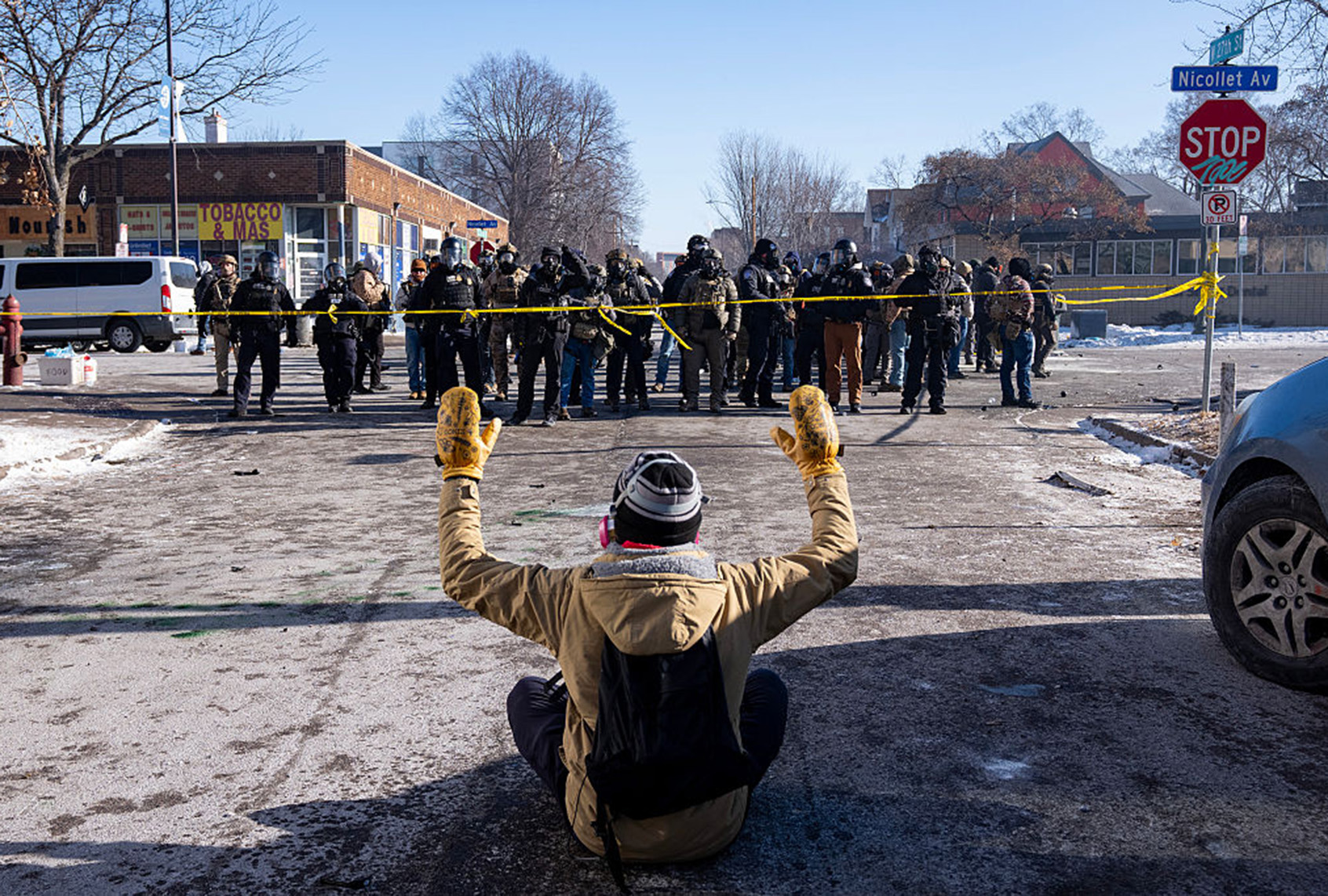
The Trump administration’s thuggery continues to grow and expand. In the aftermath of Alex Jeffrey Pretti’s killing on Saturday in Minneapolis at the hands of federal agents, hundreds of people almost immediately began to protest at the site where he was held down and shot at least 10 times. Federal law enforcement agents from Immigration and Customs Enforcement and Customs and Border Protection rained flash bangs and tear gas down on the crowd. They grabbed protesters and beat them. Witnesses described the scene as dystopian, and they had trouble believing that American citizens engaged in peaceful protest would be treated this way by their own government.
In the middle of the mayhem, an elderly man stood his ground. “They f**king killed him!,” he screamed. “I’m 70 years old, and I’m f**king angry!”
Immigration has long been one of Donald Trump’s most popular issues. A new poll conducted by POLITICO shows that 49% of Americans support Trump’s mass deportation campaign. According to the results of a nationwide New York Times/Siena poll, his support continues to collapse, with only 41% approving of his performance as president.
But while tens of millions of Americans are outraged by the growing cruelty of the Trump administration, including his mass deportation campaign, many tens of millions of others are cheering it on. Ninety percent of Republicans expressed support in a recent CBS/YouGov poll. The breakdown on racial lines is stark: A majority of white Americans support the president’s immigration policies, while a majority of non-whites oppose them.
[A] new report by the Public Religion Research Institute reveals something even more troubling about Trump’s MAGA base and the extremes to which they will go to support his mass deportation campaign and larger project to Make America White Again and creating what would be a de facto police state in America.
- For example, a majority of Americans (61%) agree that “immigrants, regardless of legal status, should have basic rights and protections such as the ability to challenge their deportation before a judge in court.” But only 37% of Republicans agree with this basic principle of American democracy, the Constitution and the rule of law.
- A majority of Republicans also support arresting and detaining immigrants who do not have a criminal record. Most Americans and the vast majority of Democrats (88%) oppose such a policy.
· Republicans, by a large majority (69%), also support putting “illegal immigrants” in internment camps until they can be removed from the country.
· Predictably, a majority of Republicans also want “illegal aliens” to be sent to foreign prisons, or gulags, in such countries as El Salvador, Rwanda and Libya without due process. A majority of Americans (68%) and an overwhelming majority of Democrats (90%) oppose such inhumane policies.
Ultimately, for Trump’s MAGA followers and the larger anti-democracy right-wing, the man screaming at the site of Alex Pretti’s killing is music to their ears. They see dystopia as a utopia. This warped vision of unlimited power, the silencing of critics and ability to impose their beliefs on those deemed to be the Other serves their goal of ending the country’s pluralistic democracy and replacing it with a White Christofascist plutocracy ruled by a very small number of powerful White men. This new America would be a union of Margaret Atwood’s “The Handmaid’s Tale,” Jim and Jane Crow, and technofeudalism. Rank-and-file MAGA followers and other members of the right-wing will not live better material lives in this world, but they will enjoy the psychological wages of being told they are inherently superior over the Other as their need for social dominance is validated.
This moral inversion further reveals a society in the grips of fascism, authoritarianism and the culture of cruelty. But the GOP is experiencing little if any cognitive dissonance between their expressed family values and Christian morality and their support for the cruel, antisocial policies of the Trump administration — and the great harm they are causing huge swaths of the public. For them, power, domination and control are what ultimately matter.
There will be many more Alex Prettis, Renee Goods and other people whose names are not yet known in the months and years ahead as the machinery of Trump’s mass deportation campaign gets up to full speed. But Pretti’s killing, as Walz said in a press conference on Sunday is an inflection point, a reckoning.
“I’ve got a question for all of you: What side do you wanna be on? The side of an all-powerful federal government that can kill, injure, menace, and kidnap its citizens off the streets? On the side of a nurse at the VA hospital who died bearing witness to such a government? Or the side of a mother whose last words were, ‘I’m not mad at you.’”
The American people are divided, living in the same country but not the same reality. Tens of millions will answer Walz’s question in ways that may rock and break Americans of conscience — especially mainstream liberals and centrists.
Democrats and other pro-democracy voices cannot assume that the increasingly not-so-silent majority who oppose Trump’s policies on immigration will give them a victory in the upcoming midterm elections. There remains a deep base of support for Trump’s policies — and their cruelty. The Democratic Party needs to stake out a firm, unequivocal moral position and then lead from there. One of the first steps toward this will be for Senate Democrats to vote against funding for ICE and the Department of Homeland Security — or at least imposing severe limits and strict oversight — and explaining in clear direct language how this will be a vote about the country’s character and the type of people we Americans want to be.

Tuesday, January 27, 2026

The Felon's Regime: Yes, It’s Fascism

Until recently, I resisted using the F-word to describe [the Felon]
President Trump. For one thing, there were too many elements of classical fascism that didn’t seem to fit. For another, the term has been overused to the point of meaninglessness, . . . . fascism has been an incoherent doctrine, and even today scholars can’t agree on its definition. Italy’s original version differed from Germany’s, which differed from Spain’s, which differed from Japan’s.I accepted President Biden’s characterization of the MAGA movement as “semi-fascist” because some parallels were glaringly apparent. [The Felon] Trump was definitely an authoritarian, and unquestionably a patrimonialist. Beyond that, though, the best description seemed to be a psychological one propounded by John Bolton, Trump’s first-term national security adviser: “He listens to Putin, he listens to Xi, he listens to how they talk about governing unburdened by uncooperative legislatures, unconcerned with what the judiciary may do, and he thinks to himself, Why can’t I do that?
Writing a year ago, I argued that [the Felon's]
Trump’sgoverning regime is a version of patrimonialism, in which the state is treated as the personal property and family business of the leader. That is still true. But, as I also noted then, patrimonialism is a style of governing, not a formal ideology or system. . . . . Fascism, in contrast, is ideological, aggressive, and, at least in its early stages, revolutionary. It seeks to dominate politics, to crush resistance, and to rewrite the social contract.Over [the Felon's] Trump’s past year, what originally looked like an effort to make the government his personal plaything has drifted distinctly toward doctrinal and operational fascism. Trump’s appetite for lebensraum, his claim of unlimited power, his support for the global far right, his politicization of the justice system, his deployment of performative brutality, his ostentatious violation of rights, his creation of a national paramilitary police—all of those developments bespeak something more purposeful and sinister than run-of-the-mill greed or gangsterism.
Then the facts change, I change my mind. Recent events have brought Trump’s governing style into sharper focus. Fascist best describes it, and reluctance to use the term has now become perverse. That is not because of any one or two things he and his administration have done but because of the totality. Fascism is not a territory with clearly marked boundaries but a constellation of characteristics. When you view the stars together, the constellation plainly appears.
Demolition of norms. From the beginning of his first presidential run in 2015, Trump deliberately crashed through every boundary of civility; he mocked Senator John McCain’s war heroism, mocked fellow candidate Carly Fiorina’s face, seemingly mocked the Fox News host Megyn Kelly’s menstruation, slurred immigrants, and much more. Today he still does it, recently making an obscene gesture to a factory worker and calling a journalist “piggy.” This is a feature of the fascist governing style, not a bug. Fascists know that what the American Founders called the “republican virtues” impede their political agenda, and so they gleefully trash liberal pieties such as reason and reasonableness, civility and civic spirit, toleration and forbearance. By mocking decency and saying the unsayable, they open the way for what William Galston has called the “dark passions” of fear, resentment, and especially domination—the kind of politics that shifts the public discourse to ground on which liberals cannot compete.
Glorification of violence. Every state uses violence to enforce its laws, but liberal states use it reluctantly, whereas fascism embraces and flaunts it. Trump thus praises a violent mob; endorses torture; muses fondly about punching, body-slamming, and shooting protesters and journalists; and reportedly suggests shooting protesters and migrants. His recruitment ads for ICE glamorize military-style raids of homes and neighborhoods; his propaganda takes childish delight in the killing of civilians . . . . Like the demolition of civic decency, the valorization of violence is not incidental to fascism; it is part and parcel.
Might is right. Also characteristic of fascism is what George Orwell called “bully-worship”: the principle that, as Thucydides famously put it, “the strong do what they can and the weak suffer what they must.” This view came across in Trump’s notorious Oval Office meeting with Ukrainian President Volodymyr Zelensky . . . . Stephen Miller, the president’s most powerful aide, told CNN’s Jack Tapper: “We live in a world, in the real world, that is governed by strength, that is governed by force, that is governed by power. These are the iron laws of the world that have existed since the beginning of time.” Those words, though alien to the traditions of American and Christian morality, could have come from the lips of any fascist dictator.
Politicized law enforcement. Liberals follow the law whether they like it or not; fascists, only when they like it. Nazism featured a “dual state,” where, at any moment, the protections of ordinary law could cease to apply. Trump makes no secret of despising due process of law; he has demanded countless times that his opponents be jailed . . . and he has suggested the Constitution’s “termination” and said “I don’t know” when asked if he is required to uphold it. His single most dangerous second-term innovation is the repurposing of federal law enforcement to persecute his enemies . . .
Dehumanization. Fascism draws its legitimacy from its claims of defending the people from enemies who are animals, criminals, brutes. [The Felon]
Trumpcharacterizes (for instance) political opponents as “vermin” and immigrants as “garbage” who are “poisoning the blood of our country” (language straight out of the Third Reich).Police-state tactics. Trump has turned ICE into a sprawling paramilitary that roves the country at will, searches and detains noncitizens and citizens without warrants, uses force ostentatiously, operates behind masks, receives skimpy training, lies about its activities, and has been told that it enjoys “absolute immunity.” He more than doubled the agency’s size in 2025, and its budget is now larger than those of all other federal law-enforcement agencies combined, and larger than the entire military budgets of all but 15 countries. . . . . Kristi Noem’s recent appearance with a sign reading One of ours, all of yours seemed to nod toward another fascist standby, collective punishment—as did the administration’s decision to flood Minneapolis with thousands of officers after residents there began protesting federal tactics, a prioritization that was explicitly retributive.
Undermining elections. Trump’s recent musing that there should be no 2026 election may or may not have been jocular (as the White House has maintained), but he and his MAGA supporters believe they never lose an election, period. . . . . . Rigging, stealing, or outright canceling elections is, of course, job one for fascists. Although Trump is term-limited, we must not expect that he and his MAGA loyalists will voluntarily turn over the White House to a Democrat in 2029, regardless of what the voters say—and the second insurrection will be far better organized than the first.
What’s private is public. Classical fascism rejects the fundamental liberal distinction between the government and the private sector, per Mussolini’s dictum: “No individuals or groups outside the State.” Among Trump’s most audacious (if only intermittently successful) initiatives are his efforts to commandeer private entities, including law firms, universities, and corporations.
Attacks on news media. Shortly after taking office in 2017, Trump denounced the news media as “the enemy of the American people,” a phrase familiar from dictatorships abroad. His hostility never relented, but in his second term, it has reached new heights. Trump has threatened broadcast licenses, abused his regulatory authority, manipulated ownership deals, filed exorbitant lawsuits, played favorites with journalistic access, searched a reporter’s home, and vilified news outlets and journalists. Although Trump cannot dominate news media in the United States in the way that Prime Minister Viktor Orbán has done in Hungary, he is running the Orbán playbook.
Territorial and military aggression. One reason I held out against identifying Trumpism with fascism in his first term was Trump’s apparent lack of interest in aggression against other states; if anything, he had seemed shy about using force abroad. Well, that was then. In his second term, he has used military force promiscuously. . . . The same goes for his contempt for international law, binding alliances, and transnational organizations such as the European Union—all of which impede the state’s unconstrained exercise of its will, a central fascist tenet.
Mobs and street thugs. The use of militias and mobs to harass, rough up, and otherwise intimidate opponents is a standard fascist stratagem (the textbook example being Hitler’s Kristallnacht pogrom in 1938). As few will need reminding, the Trump-MAGA parallel is the mob and militia violence against the U.S. Capitol on January 6, 2021.
Alternative facts. As Orwell, Hannah Arendt, and practically every other scholar of authoritarianism have emphasized, creating a reality-distortion field is the first thing a fascistic government will do, the better to drive its own twisted narrative, confuse the citizenry, demoralize political opponents, and justify every manner of corruption and abuse. While other presidents (including some good ones) have lied, none have come close to Trump’s deployment of Russian-style mass disinformation . . .
The resemblances are too many and too strong to deny. Americans who support liberal democracy need to recognize what we’re dealing with in order to cope with it, and to recognize something, one must name it. Trump has revealed himself, and we must name what we see.

Monday, January 26, 2026

Sunday, January 25, 2026

MAGA's Defense of Immigration Raids is Backfiring

The [Felon's]
Trumpadministration has thoroughly failed the conservative information ecosystem credited with elevating [the Felon]Donald Trumpback into the White House. Right-wing media wanted pictures of dangerous criminals being arrested for mass deportation by Immigration and Customs Enforcement. Instead, they’ve gotten images of toddlers detained, a 37-year-old mother shot dead, an elderly grandfather dragged from his home and minor U.S. citizens injured and in trauma units. A now-infamous story of Liam Conejo Ramos, a five-year-old in Minneapolis taken by ICE on Tuesday, is the perfect illustration of how fractured the media landscape has become in the age of Trump — and how the right’s hermetically sealed system is now undermining the administration’s deportation policies.To many Americans, the viral image of a child swept up in an enforcement dragnet is horrifying. Yet in the right-wing media silo, the reaction — if there has been any at all — is not concern but suspicion. Conservative outlets have insisted the story is a lie and are clearly exasperated by the widespread coverage of the child’s after-school arrest and transfer to a detention center over 1,300 miles away in Texas.
The most revealing aspect of the right’s current meltdown over anti-ICE protests is their confusion. MAGA world is flailing and sputtering, trapped inside a media ecosystem that no longer reaches reality. The result is a whack-a-mole defense of ICE that keeps collapsing under the weight of evidence, public outrage and even the testimony of people the right used to trust: cops.
When off-duty cops in Minneapolis revealed this week that ICE agents are stopping and handcuffing them, and even pointing guns at them, MAGA simply shrugged. Fox News made only passing mention. . . . . Meanwhile, the [Felon's]
Trumpadministration’s lies have morphed beyond routine bureaucratic spin into wild, easily refutable fabrications. When DHS posted that one of their targets was “at large” and dangerous after they had smashed down doors and dragged a U.S. citizen into the snow half-naked, local journalists located the actual suspect in state prison within minutes using a public database. When immigration officers pepper-sprayed a vehicle with children inside as a family drove home from a basketball game, DHS posted on social media: “It is horrific to see radical agitators bring children to violent riots” before deleting the post.When they dragged Aliya Rahman, a U.S. citizen recorded telling agents she is autistic with a traumatic brain injury, from her car on the way to a medical appointment, a DHS spokesperson called her an agitator obstructing immigration operations.
How can anyone trust evidence produced by people who openly brag about their digital deceptions? Conservative influencers are nevertheless trying to explain away images of federal agents in masks pepper-spraying protesters in the face while pinning them to frozen pavement. Minneapolis has exposed something the right-wing media apparatus can’t spin away — and now their carefully constructed alternate universe is collapsing around them.
The administration’s credibility is shot. Border Patrol Chief Greg Bovino claimed on Tuesday that “everything we do every day is legal, ethical, moral, well-grounded in law.” But ICE’s own training documents contradict that. A whistleblower revealed this week that agents are now entering homes without judicial warrants, using only administrative warrants they sign themselves.
To be certain, there is a faction of Americans who want desperately to support Trump’s consolidation of power, and they have latched onto immigration because they believe — correctly, until recently — that it’s his strongest issue. . . . . But when you campaign on a promise of an unprecedented mass deportation, you eventually have to carry it out. And the brutality of executing it — masked agents, warrantless home raids and pepper spraying babies — is proving politically unbearable.
The Trump administration made a catastrophic miscalculation: They thought they could control the narrative through sheer force of lying. Now the cracks are showing everywhere. The great irony is that Trump’s 2024 achievement — expanding the Republican coalition — is being destroyed by his signature campaign promise of mass deportation executed with maximum cruelty.
The killing of Renee Nicole Good first exposed this fault line. In the immediate aftermath of her death, the Trump administration adopted an absolutist, no-apologies posture that was chilling even by American policing standards. Typically, when law enforcement kills a civilian, there is at least a ritual performance of solemnity: condolences and promises of an impartial investigation, along with an acknowledgment, however hollow, that taking a human life is a grave matter.
Trump himself awkwardly admitted during a rambling press briefing on Tuesday that ICE “is going to make a mistake sometimes” . . . . But even this admission appears to be strategic, a softening of their rhetoric while maintaining the same brutal enforcement, all the while hoping Americans won’t notice the contradiction.
On Thursday night’s episode of CNN’s “NewsNight,” Jim Schultz, a former White House Trump attorney, conceded as much. “I think Republicans are losing the argument here because of the way it’s being conducted in the streets,” he said. “No doubt about it.”
The right built an impenetrable information fortress precisely to avoid moments like this. Conservative influencers, podcast bros and Fox News were supposed to form an unbreakable wall of narrative control. But the [Felon's]
president’spolling collapse is stunning.Trump’s net approval among Gen Z voters has plummeted from positive 10 points in February 2025 to negative 32 points now, a catastrophic 42-point drop in less than a year, according to a New York Times/Siena poll released Thursday. These are the same young voters, especially young men, who helped carry Trump to victory by shifting 13 points in his direction from 2020. 70% of voters under 30 now disapprove of his performance as president. While Trump’s approval on immigration was split 50-50 among voters in March 2025, 61% now disapprove, including seven in 10 independents who say ICE has gone too far.
Trump knows he’s losing the narrative. That’s why he announced he was revising a lawsuit against the New York Times over polling that showed only 34% of independents approve of his job performance, threatening that “fake and fraudulent polling should be, virtually, a criminal offense.”
The right-wing information barrier that protected Trump from political consequences is crumbling. The manosphere is fragmenting. He can sue pollsters and threaten to investigate whomever he wants, but he can’t make Americans unsee what’s happening in Minneapolis.

Subscribe to:
Comments (Atom)